Thursday, April 29, 2021

Uncle Jonesy's Cameras Podcast #31: A Conversation with Earth Sun Film's Jerome Carter


My recent discovery of the Earth Sun Film blog has resulted in not only many happy hours of reading, but also some valuable inspiration with regard to my photography, as detailed in my previous blog post. In show #31 I had the fine pleasure of having a conversation with the author of Earth Sun film, Jerome Carter. In the course of our chat, Jerome explained how he began a serious pursuit of film photography as a means to making better photographs of his flower garden endeavors, how he came to create the Earth Sun Film blog, how gardening and photography has changed his life, and how he came to use Minolta cameras and appreciate the story of the Minolta company. I think you will find his story compelling as well as inspiring, and if you are a user of Minolta gear, you are in for a treat.

Please check out Jerome's blog, Earth Sun Film. Naturally, I enjoyed the posts on his journey into film photography and his Minolta love. However, even if you care little for gardening, I believe you will enjoy reading the stories he tells as well as seeing his photography work. 

As always, we here at Uncle Jonesy's Cameras would love to hear from you, so send us an email at unclejonesyscameras@gmail.com. You also can find us on Facebook and Instagram

Happy Shooting!


Friday, April 23, 2021

Borrowed Gardens Project #1: I Am Not a Gardener

Dogwood Tree, Chattanooga, Tennessee
Minolta X-570, Rokkor MD 50mm f1.7, Kodak Color Plus

Today's post is the first of an ongoing series I am planning throughout the year and the beginning of a new project (you know who you are, project-oriented people). This ongoing project will combine my love of photography and my love of . . . 

I was going to say "my love of gardening," but truth compels me to say that . . . I am not a gardener.

Ok, I have done scant bits of gardening in the past. In fact, every spring my wife, Debbie, and I would journey to Lowe's and bring home yard supplies like mulch, week killer, lawn feed, and some colorful flowers to plant in the various flower beds and planters around our house. I happily watered and weeded our plantings, and the bright colors would bring us happiness throughout the long hot north Georgia summer. Nevertheless, the rest of the lawn was a major chore, and it was all done knowing that, no matter how much work and money I invested in it, by July I would be mowing and trimming crabgrass instead of fescue. 

Honeysuckle along the Tennessee Riverpark, Chattanooga
Minolta Maxxum 600si, Minolta AF 50mm f1.7, Kodak Ultramax 400.

When Debbie and I moved to our one bedroom condo in downtown Chattanooga in October of 2019, lawn work was one of the things I was most thankful to be rid of. Besides, our proximity to the riverwalk, numerous parks, and landscaped public buildings meant that we plenty of gardens to explore and enjoy, and straightway we began to do so. And as we did, I discovered that I loved flower gardens more than I had ever realized before! Here were places of great beauty, artfulness, mindfulness, and peace. I wanted to capture those experiences, and it wasn't long before the possibilities of photography began to swirl in my brain.

Golden Ragwort near my condo.
Minolta Maxxum 600si, Minolta AF 50mm f1.7, Kodak Ultramax 400.

Coincidentally, I had just discovered a new blog, Earth, Sun, Film, by Jerome Carter (I discuss my high regard for this blog in the Uncle Jonesy's Cameras Podcast #30). Mr. Carter is a gardening enthusiast, having abandoned his failing front lawn and replaced it with a flower garden in 2014. Initially, he used his iPhone to document the progress (and failures) of his garden, but in early 2019 he purchased a film camera (a Minolta Maxxum 7000i) so that he could blur backgrounds and do other things his iPhone could not do. Since then, Mr. Carter has pursued his gardening and photography passions and recorded his learning in his blog. Since I am a sucker for blogs that will teach me something, I was immediately hooked. Of course, his choice of Minolta resonated with me as well. Obviously, he had good taste in cameras.

As I read through the posts in Earth, Sun, Film, I saw not only the progress Mr. Carter was making in his photography, but also I became a kind of "student" in his classroom. I paid attention as he carefully explained what he had learned from the many books he had read, classes he had taken, and the many hours of practice he put in with his cameras. I realized that I, too, wanted to make photographs of flower gardens in an effort to capture the peaceful moments spent there. But while Mr. Carter had his own garden to photograph, I have no garden nor a place to plant one. 

Golden Ragwort and Vinca, Townsend (Tennessee) Riverwalk and Arboretum 
Minolta Maxxum 600si, Minolta AF 50mm f1.7, Kodak Ultramax 400.

That's when the idea of "borrowed gardens" popped into my head. I didn't have to "own" a garden. I have gardens all around me. Every spring the Bradford pear trees and the redbud trees are the first to bloom. Then come the dogwoods, and cherry trees. Daffodil, tulips, and iris put on a show of color. Other flowers are planted by landscapers of the condo buildings which continue to be build all around us. Debbie and I even have memberships in commercial "gardens" like Rock City Gardens and Gibbs Gardens, just so we can stroll peacefully through a garden without having to plant one ourselves. Why not photograph them as if they were ours? I’ll just "borrow" them, thank you.

Live Oak, Spanish Moss, and Azalea, Jekyll Island, Georgia 
Minolta X-570, Rokkor MD 50mm f1.7, Kodak Color Plus

And so today I introduce my new project, the Borrowed Gardens Project. For this project, I will be attempting to capture the beauty, artfulness, mindfulness, and peace of gardens that belong to someone else, like the colorful plantings of the expensive townhouses along the Tennessee Riverwalk, just a short walk from our condo, or the landscaping surrounding the county courthouse, or the walking trail along the Little River in Townsend, Tennessee, that is cared for by the local garden club. Even a springtime blooming tree like the many dogwood trees in Chattanooga or the ubiquitous azaleas on Jekyll Island will become opportunities to practice composition, exposure, and focusing skills. I will even take the time to research the flowers and learn their names (Debbie is a big help with this). Hopefully, I will have pretty photographs of flowers post online and to print and give away to friends and neighbors in my condo building. And along the way I will become a better photographer. At least that is the idea. 

All photographs were developed by me at Safelight District Community Darkroom in Chattanooga, Tennessee.

Fringe Tree near my condo.
Minolta Maxxum 600si, Minolta AF 50mm f1.7, Kodak Ultramax 400.


Monday, April 12, 2021

One Negative - Thirty-Nine Years

Driftwood Beach, Jekyll Island, Georgia, December 1982. The original print, made in early 1983, is
on the right. The print on the left was made in April of 2021. 

If you have been shooting film as long as I have, you will remember getting your prints back from the photo lab in two-pocket envelopes, one pocket for the prints and one pocket for the negatives. The prints would be added to photo albums, stuck to refrigerators, passed around, given or mailed to family members and friends, and then stored in boxes or even the envelope in which they came. But what about the negatives? Unless used to make reprints, the negatives rarely left the envelope. Over time, the negatives began to take up more and more space, and I now wonder how many people simply threw out the negatives in the belief that they would no longer be needed. 

I am glad to say that I still have most, if not all of our negatives, and recently I had a chance to reconnect with a thirty-nine year old negative that I shot on Jekyll Island, Georgia, in late December of 1982. Here is the backstory:

During the week after Christmas, 1982, my parents took me, Kelley, and our younger brother, Mike, to Jekyll Island for a week. We stayed in a rented house near the beach, and the idea was that this might be the last "family" vacation for the five of us. Kelley and I had left our teaching jobs to continue our education, and Mike had just entered college the previous fall. We all were going in different directions, so it was good to have this time together, especially in such a magical place. We took lots of walks around the island, and I took lots of photos (Kodachrome slides in my Minolta XG-1 and Kodak Tri-X 400 in my Minolta SR-T 201). One of those took us to the northern tip where the beach erosion had creating a moody but magnificent landscape called Driftwood Beach. Dying live oak trees jut skyward in bizarre directions as the surf constantly berates and eventually brings them down as driftwood scattered on the sand. On this particular day, the sky was overcast with rain eminent, and I was glad that I had 400 ISO film in my camera. As I walked the beach, I saw a single dead live oak tree with most of its branches missing and its roots exposed above the sand. The tree appeared to be pointing to a healthy tree farther down the beach, but the pounding surf may soon reach it as well. It is as if the dead tree is predicting the future of the healthy tree. I raised my camera to my eye and framed a shot of the dead tree with the healthy tree in the distance. 

This film was in my camera the day I shot frame #20 that day on
Driftwood Beach, in late December, 1982. 

At that particular time, I was attending a small bible college in southwest Atlanta. I shot black and white photos for the college yearbook and developed and printed the photos in the small darkroom on campus. It was my first experience making prints in an actual darkroom, and although I didn't really know what I was doing, I loved it. I was allowed to develop and print as much of my own photographs as I wanted, and I still have some of those prints today, like the Driftwood Beach, 1982 print that hangs on the wall of my condo today. I remember how pleased I was that I could make something so beautiful (to me) completely by myself. 

Driftwood Beach, Jekyll Island, Georgia, March 2021.
Minolta Maxxum 7000, with Minolta AF 35-105mm
f3.5-4.5 zoom lens, on Kodak Tri-X 400 film. Printed 
at Safelight Community Darkroom.

Fast forward thirty-nine years. My wife, Debbie, and I have made two recent visits to Jekyll Island already this year. Our walks along Driftwood Beach were just as magical as it was for me in 1982, and I happily shot a number of frames (also on Tri-X 400). Of course, the beach is constantly changing as nature does its work, but once a photography is made, time is frozen. I began to think about that shot I made thirty-nine years ago, and it hit me:  I should try to make a new print of the old negative and see what it tells me. On a recent trip to our community darkroom, Safelight District (Chattanooga, Tennessee), I removed the negative from the sleeve where it had resided for almost four decades and began the printmaking process. My goal was not to make an exact copy of the original 1982 print but to "reinterpret" it in light of new skills I have acquired since returning to the darkroom just over a year ago. I routinely use a technique called Split Grade Printing to bring out details in the shadows while holding the right amount of highlight details and overall contrast. The resulting print looks a bit brighter, but I quite like it. While not perfect, I think it captures the mystery and wonder of the moment in my memory, as photography does.

Takeaways? Obviously, keep your negatives in a safe place. After all, it was that film that was "touched" by the light that came from your subject. The negative represents the closest you can get to the moment that was captured. It was there. Beyond that, I am happy that I can see growth (albeit small) in my printing technique. I've only ever worked in two darkrooms with a gap of thirty-four years in between, so there is much to be learned on my way to my goal of becoming a "master" printer, if that even is possible for me. However, it is my goal as I keep shooting, developing, printing, reading, and asking questions of experienced photographers. Finally, I am reminded of the essence of photography:  the preservation of an instant of light. Photography makes the temporary permanent. I have a strip of celluloid in a plastic sleeve and a silver gelatin print on the wall to prove it.

Sunrise on Jekyll Island, December, 1982. A Kodachrome taken with my Minolta XG-1.
Great colors, if not a great composition.

Walking Path Along the Salt Marsh, Jekyll Island, Georgia, December, 1982. Another Kodachrome 
from my Minolta XG-1. The lens for these color shots was the Rokkor-X 45mm f2.

Friday, April 9, 2021

Uncle Jonesy's Cameras Podcast #30: Let's Talk Cameras (and Maybe Open a Camera Store!)

The Shutter Brothers are back, and they are talking cameras, cameras, cameras! The Bros discuss their recent camera swap, which has made them both very happy. They go on to assess the current state of the camera market, and the Shutter Brothers are worried about the available of affordable cameras for newcomers to film photography. So maybe, just maybe, you will be able to visit the Uncle Jonesy's Camera Store soon (online, of course. Stay tuned . . .

Kelley swapped his Minolta X-570 for this Nikon FE . . . 

. . . and Kevin swapped his Nikon FE for this Minolta X-570.

Next, Kelley reviews his latest camera acquisition, the solidly-built Nikkormat EL. A consumer camera from maybe, but you won't find a more well-built and reliable camera body. Kelley is super excited to have it!
Kelley's newly acquired Nikkormat EL, a solid and praiseworthy 
manual focus camera from Nikon.

Finally, Kevin reviews (and highly recommends) a blog that he has been reading and enjoying lately. It's called Earth, Sun, Film, and it is the work of Jerome Carter. Jerome loves gardening and film phtography, and his blog is a chronicle of the journey his is on with his photography and what he has learned along the way. You can find it at www.earthsunfilm.com.

Speaking of blogs, we thank you for visiting the Uncle Jonesy's Cameras Blog, and we would like to invite you to follow us on Facebook and Instagram. Also, the Shutter Brothers would love to hear from you, so send us an email (include a voice memo if you like) to unclejonesyscameras@gmail.com and let us know what you have been photography lately.

Until next time . . .  

Happy Shooting!

Thursday, April 8, 2021

Back to the Bulb: The Return of the Slide Show

Since Kodak reintroduced its Ektachrome transparency (slide) in the fall of 2018, lots of people have loaded their cameras and enjoyed capturing bright, bold, and beautiful colors on one of the most colorful films available today. Kodak Ektachrome E100, simply put, is an amazing film. With it's capability of high resolution, low grain, bright but accurate colors, and wide exposure attitude, it's no wonder that photographers can't seen to get enough of the film. Yet, I wonder. How much of this slide film is being seen the way slide film was meant to be seen.

If you have followed this blog or the Uncle Jonesy's Cameras Podcast, you know all about my uncle Jonesy and all the slide film he shot as he documented our family's lives and his travels with my aunt Claire. With his Argus Autronic 1 and later his Minolta SR-T 202, his made hundreds and hundreds of slides of birthdays, family picnics, weddings, holiday gatherings. My brother, Kelley, and would gleefully watch slideshows of these events and enjoy seeing ourselves in the photos. It was on his bright Radiant brand projector screen that we first saw scenes of  New York City, New Orleans, Nassau, and the Wright brothers camp and museum at Kitty Hawk, North Carolina. Jonesy and Claire would take us to Rock City Gardens high atop Lookout Mountain only once a year, but Kelley and I could relive the experience as often as we came to visit their house. We would watch tray after tray of slides until we couldn't keep our eyes open.

Then, when I got my first real camera (a Minolta XG-1 with my first teacher paycheck), I followed in Jonesy's footsteps by shooting slide film exclusively. I documented my life, first with my friends, then with my wife, and then with my daughters. Our family would watch slide shows with the same enjoyment and enthusiasm as when I was a child. Over the years I accumulated a closet full of fully loaded Kodak carousel trays that that would illuminate a projector screen with images that documented the lives and travels of me and my family.

When I could no longer get my favorite slide film, Kodachrome, I acquired a digital camera and began documenting life by making jpegs, which were then stored on my computer. My slide projector and screen stayed in the closet, and the small computer screen became our "slide show." No wonder we didn't have many slide shows in the digital era.

So, when Kodak brought back slide film in the form of Ektachrome, I bought some straightway. The resulting scans were awesome, but viewing them on a computer screen could never replace seeing them on a bright projector screen. I wanted see see my Ektachrome slides projected on the big screen just like the old days. However, three problems stood in the way of returning to the slide shows of old.

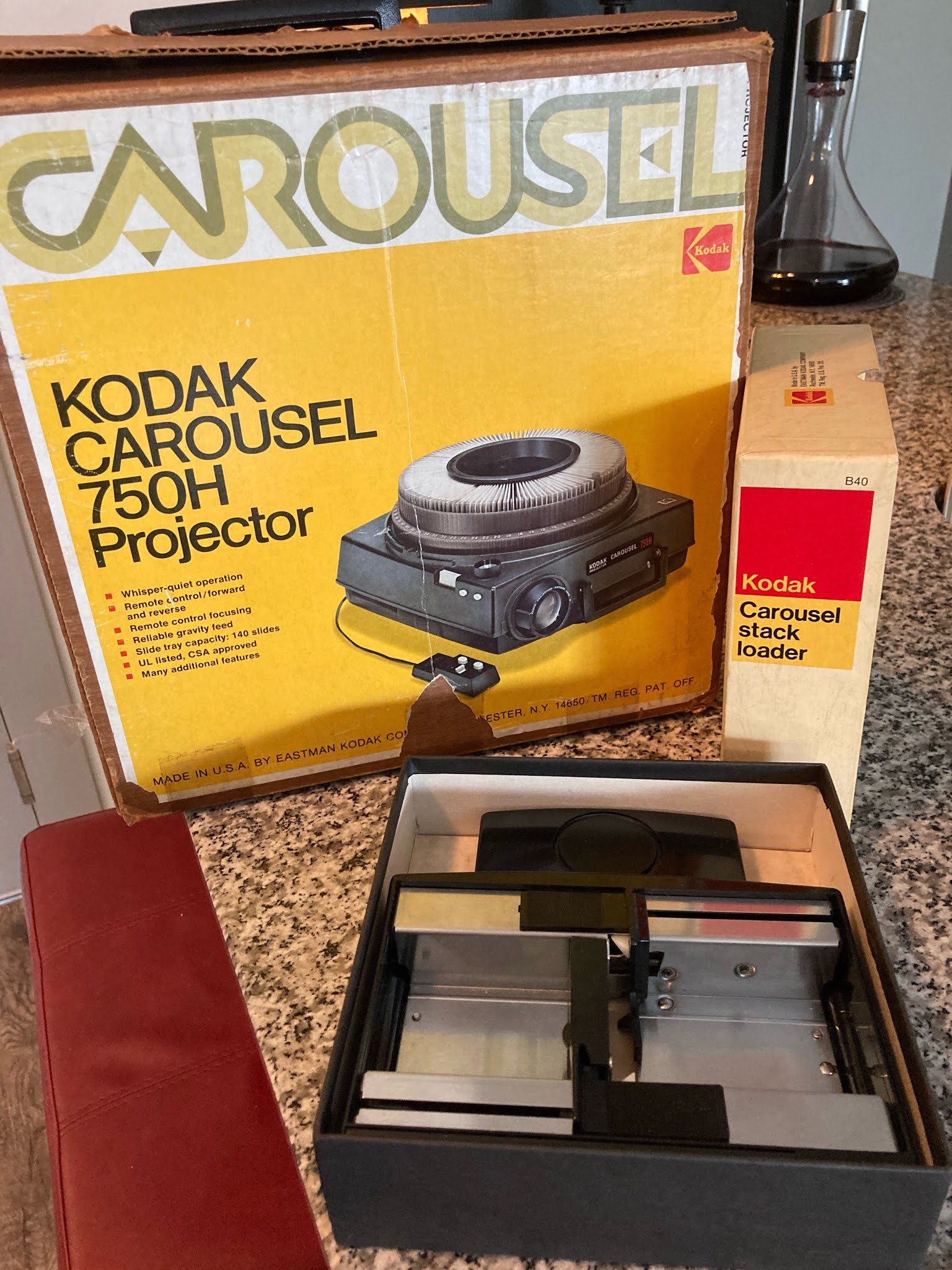
The first problem was the old projector itself. My Kodak Carousel 750H would no longer advance to the next slide, due to the deterioration of a small plastic tip attached to the solenoid the activates the advancing mechanism, a common problem. The tip can be replaced, but it is not an easy process. I ordered the parts needed, found a good YouTube video, and bravely operated on my "patient." After the reassembly, I tested it and it worked!

Carousel projector repair kit, with parts for the solenoid tip and focus gears.

Before the disassembly. The process is daunting but doable.

The second problem was our move to a small condo, and what to do with two dozen carousel trays that contained the bulk of the hundreds of slides I had shot. Taking them to the condo was not an option, so I had to a) find an efficient way to organize and store them, and b) find a way to project slides without using a carousel. The the second part was solved with the purchase of a Kodak Carousel Stack Loader (plenty to be found on eBay).
Kodak Carousel Stack Loader
This device rests on the top of the projector, feeding it slides from a stack placed in the stack loader. When all of the slides of the stack have been shown, the stack can be returned to its box with all the slides in the same order. Now, I turned my attention to slide storage. After some investigation, I found the perfect solution:  the Adorama 35mm Master Slide Storage Box with Divider Boxes. This sturdy storage box, with its six divider boxes, can store over 2100 slides. Using the supplied divider cards, one can not only store a large number of slide, but also one can organize them into sections according to date, event, place, etc., and design a way of cataloging a slide collection so as to make it possible to find specific slide stacks to project using the stack loader. Once my Adorama 35 Master Slide Storage Box arrived, I began removing slides from carousel trays and storing them in the divider boxes with notated divider cards in-between each section. After notating each divider card, I wrote the same information on the divider box, so that a glance at the box revealed what slides it contained. By the time we moved in late September of 2019, all of the slides that were in the carousel trays were now neatly stored in one master box, and I gave away all of the carousels. 

The Adorama 35mm Master Slide Storage Box with six divider boxes

Notations on the dividers and the divider box tops 

The carousels are gone, but I still have some slides to sort. Remember those yellow boxes?

The third problem was finding a way to mount slides myself. Already I was developing slide film that I was shooting (the process is called E-6, and kits are available online), but now I needed a way to put the transparencies in mounts that would fit in my projector. Once again after some research online, I ordered the AP Promounter II and a box of 100 slide mounts. The AP Promounter II makes mounting slides easy; I can mount an entire roll of film in a few minutes. Then I store the resulting stack of slides in one of the divider boxes until show time.

The AP Promounter II and a box of mounts.

Align the frame line to the arrows, slide the cutter blade, 
and pull out a mounted slide!

Mounted slides:  Little stained glass windows!

Needless to say, being able to see not only all my many old slides but also the new slides I'm making on the big screen is as entertaining as I hoped. Moreover, we have been taking projector, screen, and some divider boxes with us on visits to family for old fashioned slide shows, reliving cherished moments of the past with our children and memories of our travels. There always comes a moment where I have to say, "Ok, this is going to be the last stack," because they always want to see more. And to be honest, so do I. The slide show is back!

Debbie and me, photographed by Uncle Jonesey on our 
first wedding anniversary and now on the big screen.

My family on Easter morning, 1994,
photographed by me with my Minolta X-700
on Kodachrome.


Sunday, March 21, 2021

Uncle Jonesy's Cameras Podcast #29: Let’s Swap Cameras!


Kevin happily swapped his Nikon FE for this!
All around the world, the seasons are changing, cameras are being loaded, and moments and places are being preserved on film. It’s what we do! In this solo show, Shutter Brother Kevin talks about his recent camera swap with fellow Shutter Brother Kelley. Kelley has been looking for a Nikon manual focus camera body to serve as a back-up to his Nikon F3, which currently is being serviced. Since Kevin has not been using his Nikon FE lately, he offered to swap it with Kelley, and in return he got a super nice Minolta X-570. The X-570 is a very close sibling to the Minolta X-700, but Kevin explains why it could become a personal favorite.

Next, Kevin talks about some seemingly “ordinary” photographs that were accidentally added to his television screen saver but are now cherished memories of places and events from the past that are no longer around. Whenever we photographers are feeling uninspired, using your camera to record the ordinary in life is not only good skills practice, but it helps to avoid regret for the photographs you wished you had taken.
Kevin's drum set and home recording studio are
gone, but this photograph captured the memories.


Red Oak Creek Covered Bridge, Woodbury, Georgia
Minolta Maxxum 7000 and Kodak Pro Image 100 film.
Then, Kevin relates his initial experience with Kodak Pro Image 100 color negative film. Kodak labels this film as a “professional” like Portra, Ektar, Tri-X, and TMax, but Pro Image 100 costs the same as Kodak's “consumer” films like Gold 200, Color Plus 200, and Ultramax 400. The box states that Pro Image 100 is for “weddings, portraits, and events,” but Kevin forgot to read the box and used the film to photograph some landscape and nature scenes. How did the film do? Listen to find out.

Finally, Kevin reviews a wonderful coffee table book from the Anonymous Project called, Mid-Century Memories by Lee Shulman. The book presents almost 300 color images taken from the 700,000 images collected by the Anonymous Project, an organization that collects vintage color slides that have become “orphaned.” An orphaned photograph is one that has been separated from the people who were involved with its making to the extent that the identities of the people in the photograph are unknown. The photos in this book beautifully display everyday (and not so everyday) moments of people who, thanks to the available of affordable color film, were persistent in using their camera to record their lives on film. And the film of choice overwhelmingly was Kodachrome. Needless to say, Kevin loves this book!

You can listen to UJC #29 on your favorite podcast source or by clicking here.

As always, the Shutter Brothers would love to hear from their listeners. You can email them at unclejonesyscamera@gmail.com. You can follow the podcast on Facebook and Instagram at @ujcpodcast.

Happy Shooting!

Tuesday, March 16, 2021

In Praise of the (not so) Lowly Minolta XG-1 (My First Real Camera)

There can be only one first camera. This is the story of mine.

In late summer of 1980,  having graduated from Tennessee Tech University with my B.S. in Music Education the previous June, I got my first teaching job in the same greater Atlanta area school district where I when to high school. I had to wait for over a month for my first paycheck to be deposited into my bank account, but on that glorious day (a Friday, I think) my brother, Kelley (who like me had also gotten a music teaching job in the same district) got into his car and headed downtown to an Atlanta camera store and purchased our first real cameras. Time has blurred our memories, and neither of us can remember precisely the name of the retailer, nor do we have any paper work still. (UPDATE:  Through some research, I now know that it was Crown Camera Exchange at 980 Piedmont Avenue NE. The building now houses a restaurant.) I do remember vividly, as we drove home with two brand new boxes each (one for the camera body and one for the lenses), how excited we both were to finally have “real cameras,” and straightway we loaded them with film we also purchased and put them to use. 

What cameras did we bring home that day? The lowly Minolta XG-1. Why this camera? Two reasons: First, we were very familiar with Minolta cameras already, as we had eagerly watched our Uncle Jonesy use his SRT-202 many, many times. Second, the cost. Kelley and I had searched the newspaper cameras store ads diligently all summer looking for bargains. As autumn came and we began our new jobs, we found the best bargain yet:  a brand new SLR and lens for less then $200.

First introduced in 1978, the Minolta XG-1 was a budget camera intended beginning photographers who wanted to get into 35mm photography with a single lens reflex camera as cheaply as possible. Although it was a small-bodied lightweight that fit nicely in the hands, it lacked several features found on Minolta's more advanced (and more costly) XD series cameras. For example, although the XG-1 had both an aperture priority auto exposure mode and a manual mode, the meter would not function in manual mode at all. Clearly, the camera was not meant to be used in manual mode, and if you did, you were on your own in determining exposure. Additionally, the viewfinder was limited in the information it gave you. The selected aperture was not displayed, so I had to take my eye away from the viewfinder and look at the lens itself to change the aperture. Also, even though the shutter speeds were represented by LED dots next to the numbers, only a single dot represented between 1/30 and 1second. And like I said, these LED's only lit up when the camera was in auto exposure mode.


Consequently, I used the auto exposure mode all the time. I would set an aperture, and the camera would choose the correct shutter speed and display its choice in the viewfinder with LED-lit numbers. However, the XG-1 did have one very useful feature that I should have taken more advantage of:  exposure compensation. By pushing a small button near the shutter speed dial, you can add or subtract exposure up to two stops in half-stop increments. Why would you want to do this? Because all camera meters want to made every lighting situation "average," and they get fooled sometimes in certain light situations of with certain subjects. For example, when photographing snow, the camera's meter sees a lot of light being reflected back to it and thinks that less exposure is needed.
When you see the resulting photograph, the snow looks gray instead of white. By adding a stop or two, you override the meter's choice and make the snow look like snow. For darker subjects, you would do just the opposite. Some lighting situations require compensation as well. For example, when shooting a sunset, adding stops ("opening up") will give detail to objects in the foreground, while subtracting stops ("stopping down") will make them silhouettes. I made quite a few underexposed and overexposed slides in my early days of using this camera because I did not use exposure compensation.

I should say something about the lens that was bundled with the camera that day in 1980, the Minolta Rokkor MD 45mm f2. Today collectors call this type of lens a "pancake" lens because of its shorter length. I do remember looking at it and thinking that it didn't look as "professional" as those bigger 50mm f1.2 lens I would see in the brochures I collected. However, nowadays the 45mm f2 is sought-after by those who want a lighter and less obtrusive lens and a slightly shorter focal length on a standard lens. 

The XG-1 also lacked some other nice features like depth of field preview, and film memo clip. It didn't have the bright accu matte focusing screen or the silicon cell meters that it's more expensive siblings had. But I didn't care about any of that at all. I had a "real" camera for the first time, and I shot and shot. My film of choice was Kodachrome, and I put dozens and dozens of rolls of film through my XG-1. When I look at those slides today, I have to say that results were pretty good and sometimes really good. The 45mm f2 performed quite well, producing nice sharp images with good color rendition. However, with all cameras, it is the photographer who makes the photograph. The more I shot with it, the more I learned. I think there is a lesson in that. 

Old Salem, North Carolina, 1987
Kodachrome 64, Minolta XG-1, 50mm f2 lens

Salem College, North Carolina, 1986
Kodachrome 64, Minolta XG-1, 50mm f2 lens

Chatham, Massachusetts, 1986
Kodachrome 64, Minolta XG-1, 50mm f2 lens

Today, I hear a lot of film photography hobbyists talking about the ideal first or "student" camera, and the camera that still gets mentioned the most is the Pentax K1000. Why? I suppose it is because the K1000 (like the Minolta SRT series cameras) have full metered manual control, and this is supposed to help the beginning photographer learn how exposure works. But I contend that the only way you can prove that you know how exposure works it to . . . turn off the meter and choose both the aperture and shutter speed yourself. The only way you can do this with the Pentax K1000 is to take out the battery (you can switch off the meter on the Minolta SRT series cameras). Certainly, the K1000 and the SRT cameras also are held in high regard because they have mechanical shutters. But some cameras with electronic shutters are steeples. That is, if the meter calls for a shutter speed in-between 1/60 and 1/125, it could do that.

You probably can see where I am going with this. To my knowledge, the Minolta XG-1 has never been mentioned as the "perfect student camera," but I happen to think that it is a great choice for those just getting into film photography. With an XG-1, you can just rely on the meter at first and concentrate on composition and story, two really important parts of photography that we don't talk about enough. However, it is crucial that the beginner pays careful attention to how the camera chooses the exposure. At some point along the way, the student can (and should) put the XG-1 into manual mode and shoot without the help of a meter. Of course, this requires thinking about the exposure. Sure, mistakes will be made, but that is how we learn! And I think that a greater understanding of light, which is the essence of photography, will become the foundation for exploring more creative techniques and creating a personal style.

The Minolta XG-1 is the perfect camera for this for another reason. Although like most all film cameras, it is quite inexpensive and very easy to find. You might find one at your local Goodwill (or use the Goodwill website) for less than $20 with a lens. Of course, you have to make sure that the camera works first. And here's more. The XG-1 can be used with the full line of Minolta manual focus lenses, which are not only relatively cheap and easy to find, but also very good to excellent in quality. Finally, it takes two LR 44 silver oxide batteries or one 1/3N lithium batteries, which are sold everywhere.

I would love to tell you that I still have my first real camera, that Minolta XG-1 but sadly, I do not (I still have the original owners manual, strangely). Sometime in the late 1980's the shutter locked up. I took it to a camera dealer who told me it wasn't worth fixing, so I sold it to him and bought a used Minolta SRT-201. He probably fixed the camera himself and then resold it. Who knows, maybe it's still out there somewhere.  Now, I do NOT need anymore cameras, so I am not looking to pick up an XG-1 just to add to my "collection." However, if I were to come across a cheap working one that needed "rescuing," I might not be able to retrain myself. Nostalgia can be a powerful thing, but more likely I would shoot with it some and then find a young beginning film photographer to pass it on to. I am plenty blessed with nice cameras, but there can be only one first camera. The Minolta XG-1 was mine. A perfect first camera, at that!

All photographs of the Minolta XG-1 camera are used under Creative Commons.