Sunday, January 20, 2019

Who Needs Control . . Test a New Camera and Film Stock at the Same Time!


As you know, whenever any kind of test is given to determine the level of performance of an object, or person, or anything else, there is the element known as “control.”  Control is the pre-determined standard that the subject of a performance test must measure up to in order to meet a certain level of performance.  When this principal is applied to the testing of new film stocks, one level of control would be to use a camera that is familiar to the user, and where its level of performance is already known.  However, as usual, I have blown the concept of “control” completely out of the water by testing a new film stock , and a new camera (that is . . new to me) at the same time!


I recently acquired a Petri 1.9 Color Corrected Super rangefinder.  Though I love using rangefinders, I have never come across this, or any other camera made by Petri.  They were a Japanese camera manufacturer that started out in 1954 making 35mm rangefinder cameras in the general spirit of Leicas.  The quality of those early cameras was pretty good.  Later on, as the company began making SLR’s and other rangefinder models, the quality would suffer, and the Petri name would be associated accordingly.  The Petri 1.9 Color Corrected Super falls in to the earlier category, making its appearance in 1958. This smart looking rangefinder camera is equipped with a 45mm 1.9 “color corrected” lens (a marketing reference to highlight the fact that the lens elements are coated), and a leaf shutter that ranges from 1/500 to 1 second, plus B.  Other features include a cold accessory shoe, PC connection, parallax correction viewfinder with green rangefinder patch, and a self-timer.  Upon holding it in my hands, I was immediately impressed with the build quality of this camera.  The film advance worked smoothly, the exposure controls were easy to operate, and the Copal leaf shutter was very quiet.  The viewfinder was bright, and the rangefinder patch was easy to see.  I couldn’t wait to shoot with this camera, so I decided to use it to test a new film shock.  Who needs control, right?


The new film stock is the Kosmo Foto Mono 100.  My brother Kevin had given me a couple of rolls of this black and white film for Christmas, so I thought I’d put this Petri 1.9 (which I had just received back from having it serviced) to good use.  Immediately I was impressed with the packaging.  Its cool design was a nice change from the traditional packaging that we have seen for decades.  As far as the film goes, I was already aware of two things.  I knew that this film stock was actually rebranded Fomapan 100.  I also knew that it had received some less-than-stellar reviews.  But it was free film, so on a rare sunny weekend here in northwest Georgia, I decided to test both the Petri and the Kosmo Foto Mono 100.  I began with a visit to a local flea market.  Shooting this film at box speed, and using sunny 16 for my metering, I wandered through the many rolls of tables filled with merchandise and clicked away.  Since I test cameras here often, folks at this flea market are used to seeing me making photos.  The Petri operated fine and the shutter was quiet as a mouse.  It does take a bit of getting used to focusing the lens, especially if you shoot SLR’s most of the time, however, the rangefinder patch with its green background was easy to see.  I finished up my test with a photo walk in downtown Dalton.  My wife and I recently moved to a little town north of Dalton called Varnell, so it was good to have some time to walk around Dalton’s historic downtown area.  I always seem to be a little less noticeable to others when shooting with a rangefinder than with a big and noisy SLR, so it was nice to shoot with this camera as I moved around the downtown area. 


I processed the Mono 100 using D-76 diluted 1:1 at 68 degrees for 8 minutes and 45 seconds.  Again, I was impressed from the moment the film came off the reel.  The negatives had a good look to them, and the development time seemed to be right on the mark. It was when I prepared to scan the negatives that I began to see a future for more use of this film stock.  These negatives lay perfectly flat in my scanner's film holder.  This is such a huge plus, since my favorite b&w film, Kodak Tri X 400 requires me to take the extra step of winding the film backwards after processing to reduce the extreme cupping that becomes such an annoyance when trying to scan the negatives.  Seeing my images on the monitor after the scanning process drove in the winning run.  These pictures were nice and sharp with a bit warmer tone and less contrast than my other favorite b&w film, Eastman XX 5222.  The film’s latitude seems to be wide (or I’m getting really good at using sunny 16!). Even though I had heard others complain about the grain, I was very pleased with what I saw in my images. 


In a time when the release of a new film stock is a rare occurrence, I am excited to see Kosmo Foto get into the film marketing business, even if the film is rebranded from another manufacturer.  This practice has actually gone on for a long time in the film industry, so it shouldn’t be a turn off.  The way I see it, If this is what it takes to bring new film stocks to the public’s attention, then I am all for it, especially with a new generation of film photographers who might be attracted to innovative promotional techniques and eye catching packaging.  Of course, it certainly helps that the film stock is of an acceptable quality, and I certainly think this Mono 100 meets that qualification. 


So there you have it.  If you come across a Petri 1.9 Super rangefinder camera at your favorite flea market or thrift store that is in good shape and for the right price, I certainly recommend giving it a try, especially if this your first foray into shooting with 35m rangefinder cameras.  And while your at it, consider giving this Kosmo Foto Mono 100 a try as well.  This could be your next favorite black and white film.


Now go get some pictures.

Wednesday, January 16, 2019

UJC #8: Dancing the Sous Vide Slide(s) & Exploring the Kosmo(s)

The Shutter Brothers are back with episode #8 with lots of fun and information about film photography, so load your camera and hop on board. First, Kevin talks about how a sous vide stick is a game changer for developing both C-41 (color negative film) and E-6 (color slide film). Your local grocery store (ALDI) may have one for sale, but you can always get one from the Film Photography Store.


Next, Kelley shares his happy experience with his Petri rangefinder and Kosmo Foto Mono B&W film. This film is the product of Stephen Dowling's Kosmo Foto website and brand. Kelley's review is very favorable, and you can get some of this film here (US) and here (Europe).


Finally, the Brothers read some listener letters and talk about the chances of Kodak bringing back more films in 2019, particularly Plus-X Pan 125.

You can find our podcast on You can find the show on iTunes, Google Play Music, Spotify, and all of your favorite directories. And, as always, please subscribe to the podcast so you won't miss an episode.

We would love to have you become a part of the show, and you can send us your questions, comments, and tips to unclejonesyscameras@gmail.com. Write to us or send us a voice memo to play on the show. You also can comment on any of our Facebook page posts.

Thanks to all our listeners and readers. You are the reason why we make this blog and podcast!

Happy Shooting!

Monday, January 14, 2019

Cooking Up Some E-6

By Kevin Lane

When I got my first quality camera in 1980 (Minolta XG-1), I immediately began shooting slide film. It was an easy call, as Uncle Jonesy shot slide film exclusively, and old fashioned slide shows were THE way we viewed photos. It was very social; a bunch of friends would come over, there would be food, and we would fire up the projector and turn off the lights. As the years went by, I just kept on shooting slide film, mostly Kodachrome. When I got married and the kids came along, I documented it all on slides, and now I have hundreds of them in my closet.

Then Kodachrome went away, film in general became harder to find and process, and I made the move to digital. You all know about how I have returned to film photography in the last two years, shooting color and B&W negative film. But lurking in my freezer were five rolls of Fuji Sensia 100 slide film, which had expired in 2008. Having become quite comfortable developing my own color negative film with a Unicolor C-41 kit from the Film Photography Project Store, I thought it was time to try out Unicolor's E-6 kit for slide film. The process is nearly the same, the main difference being the addition of a 2nd developing chemical and washing steps after each developing stage. In the washing stages, the water should be at or near the developers' temperature of 100º F.

My first attempt at E-6 back in the summer was a fail because I misread the directions and had my temps too high. My second attempt a few weeks ago went better, but trying to keep the temps at specified levels for all the chemistry and washings was not easy. When I looked at the film, I really couldn't be assured that I had done it correctly. Some colors did not look right.

Then came my sous vide unit. In case you don't know (and I didn't until a few months ago), sous vide (French for "under vacuum" is a cooking method whereby meat is cooked while sealed in a bag and submerged under heated water. A sous vide stick heats and circulates the water, so that the meat is cooked slowly but uniformly. The stick can be set to a specified temperature and time. Photography hobbyists have been using a sous vide stick to heat developing chemistry to the proper temperature and keep it there until it is used.
1st developer is in the tank;
2nd developer is ready and 100º F
When a separate thermometer is used to measure the chemistry temps, you can determine just where to set the sous vide stick temperature to get the chemistry up to the correct temp. Using the sous vide stick this way takes away a lot of the guesswork and worry and helps enforce a uniformity and consistency in a developing workflow, and uniformity and consistency are the keys to getting better results.

Back in October I shot a roll of my expired Fuji Sensia in my Minolta X-700. The photos were mainly around the Chattanooga and eastern Tennessee area. Then in December I found my sous vide stick at ALDI for only $49.99 and took the plunge. I filled a plastic waste can with water, put my chemistry bottles and the sous vide stick in, set the temperature and let it do it's thing. I found that my chemistry gets to the needed 100º F when the sous vide is set to around 108º F, but room temperature and plastic vs. metal or glass bottles may change that for you. You have to experiment. Once I found it, though, I did not have to worry about my temps. And as for the washings, I would fill up my gallon pitcher with tap water, measuring the temp as it came out of the spout. I figured that temperature is not as critical for the water as it is for the chemistry, and the results back me up.
Nothing beats seeing slide film when it
comes out of the tank!

Speaking of results, here are some shots from the roll. If this is the result that I can expect from developing slide film at home, then I will be shooting a lot more of it in 2019, namely Kodak's newly released Ektachrome.

Add caption


Saturday, January 5, 2019

UJC #7: Goals, Gifts, and Gear (and Happy New Year!)

The Shutter Brothers (Kelley and Kevin Lane) are back with our best show yet (at least we think so!) We start the new year by discussing our photography goals for 2019, and we would love to hear about yours. Next, we answer a great listener question about how we choose what camera(s) to shoot on a given day. Our answers are quite different from each other which came as a bit of a surprise to us. If you have a lot of cameras, we would love to hear from you about how you choose a camera to shoot. Finally, we reveal our Mystery Christmas Gift Cameras. Independently, we each bought a camera to give as a gift to each other for Christmas, so now we discuss our experiences in shooting them.
Kelley's Minolta H-Matic
Kelley received a handsome Minolta Hi-Matic AF2, and autofocus and auto exposure point and shoot with a great lens, while Kevin got a Zorki 1c, which is an early 1950's Russian copy of a Leica II rangefinder. It was a merry Christmas indeed!

You can find our podcast on You can find the show on iTunes, Google Play Music, Spotify, and all of your favorite directories, and we really hope that you will click the "Subscribe" button. That way, you won't miss any future shows. Most importantly, we would greatly welcome your feedback in the way of comments, suggestions, questions, tips, tricks, etc. You can email us at unclejonesyscameras@gmail.com. You can even record a voice memo on your smart phone and send email it to us to play on the show. We also have a Facebook page at @UJCPodcast. You can leave comments and questions by commenting on our posts there.

We would love for Uncle Jonesy's Cameras to become a community of film photographers, all sharing with each other and encouraging each other to keep shooting.

Happy Shooting! (and Happy New Year!)

Monday, December 24, 2018

UJC #6: A Sack Full of Cameras

It’s Christmas Eve, and Old St. Nicholas is getting ready to open his sack of goodies and give presents to all the good girls and boys. And if you've really been good, Santa is going to give you a brand new (old) film camera.
A Zenobia, a Yeshiva Mat 128 G, and a Petri 1.9, gifts all.
So get ready as the Shutter Brothers run down some of their recent camera acquisitions, including three really cool cameras that have been given to Kelley recently, a Zenobia, a Petri 1.9, and a Yashica Mat 128 G (isn't he so lucky!). Kevin talks about a recent antique store find, the Canon Canonet 28 (big things come is small packages), and both Kelley and Kevin talk about how instant photography is perfect for the holidays.

The Canon Canonet 28
The Uncle Jonesy's Cameras Podcast is available on all your favorite podcast directories. Please consider subscribing to the podcast. Also, we would love to hear from you, so please email us at unclejonesyscameras@gmail.com. Send us a voice memo and be a part of the show. And thanks to all of you who have listened to the podcast, read an article on this blog, and/or visited our Facebook page. We are grateful for each and every one of you.

Happy Shooting!

Instant Christmas Magic

*** This Post Comes From Kevin Lane ***

Ok, I'll admit it. I love this time of year. Yes, I know it has it's stresses, and I hate the obsession with "things that will make you happy." I've reached the stage in my life when the value of relationships becomes paramount, which is why this time of year has so much meaning to me. My favorite thing about time of year is getting together with family and friends to eat, drink, laugh, love, and celebrate "togetherness." It's something I look forward to all year.

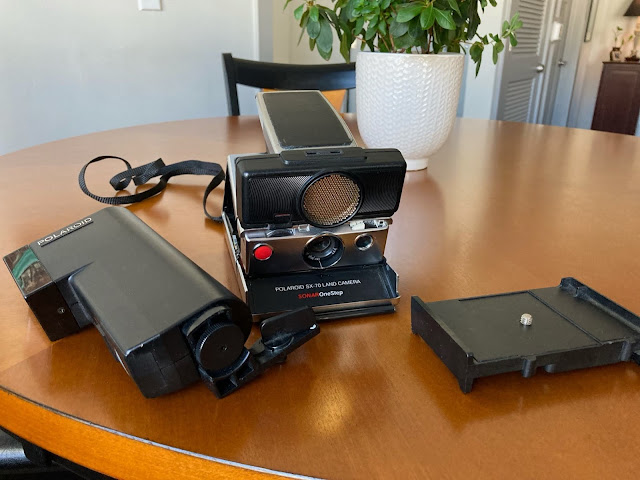
So, it should come as no surprise to anyone at these gatherings when the cameras come out. While everyone else is shooting with their camera phones, I will be firing my flash and capturing holiday memories on film. I say "cameras" because usually I shoot more then one. And one of those cameras likely will be my Polaroid SX-70 SONAR.
I love using this camera at parties, partly because of the amazement it creates when people hear it fire and see that piece of film eject from the front, but really for another practical reason. People can see the photograph moments after I take it. And more often than not, that photograph will go home with them when they leave and end up being displayed somewhere in their home. You don't always get that with a photo from a phone.

My Polaroid SX-70 SONAR One Step camera and Polatronic Flash, all from 1977.


My youngest daughter, Megan, and her guy, Devin, taken on Polaroid
Originals SX-70 color film

On show #6 of the Uncle Jonesy's Cameras Podcast, Kelley and I discuss why instant photography is a perfect choice for the holidays, especially if you are a film shooter. Everyone is super-busy this time of year, and finding time to develop your holiday party film isn't easy. Shooting an instant camera solves that problem, not to mention the cool gifts the photos become when you give them away. It truly is better to give than to receive.

You have two choices for instant photography:  FujiFilm Instax and Polaroid Originals. Instax cameras and film are everywhere nowadays and are very popular with young people. There will be thousands of Instax cameras found under the tree on Christmas morning. The photos (ten to a pack) develop quickly and look good. The film can be purchased at your local drug store. With Polaroid, it's a bit different. First of all, the Polaroid Originals film is more expensive than Instax film, and it produces only eight shots.  The Polaroid Originals film takes longer to develop (especially the color film), and the quality can be uneven (again, especially the color film - the black and white film looks great). Second, you have the option of using one of the thousands of vintage Polaroid cameras that can be found in antique store, thrift stores, closets, online, all waiting for a fresh pack of film to bring them to life. My SX-70 SONAR dates back to 1977. I also have a 600 OneStep Close Up, which I rarely use, because the SX-70 is a much better camera - easily the best camera Polaroid ever made. For this reason, there are not as easily found as the 600 type cameras like the OneStep Close Up, which has a lot of plastic about it, including the lens. However, you are much more likely to find 600 type cameras as all of the above-mentioned places. The big question regarding vintage Polaroid cameras is:  Will it work when you insert a fresh film pack into it? Unless the person who is selling the camera can confirm that it has been tested and is working, the only was to know is to do is to try it out. If it powers up, great. If not . . . I keep empty film packs that still have good batteries to test cameras with, and after you successfully shoot your first pack, you will have one, too. 

Of course, you purchase a brand new Polaroid camera, the Polaroid Originals OneStep 2, which was introduced last year. The OneStep 2 looks similar to previous 600 type cameras, but it has a lot of updated features like an onboard rechargeable battery, which makes the battery in the film pack no longer necessary. The camera has gotten some good reviews, and because the I-Type film packs the camera uses don't have a battery in them, they are about three dollars less than SX-70 or 600 packs. Unless you already have access to a vintage camera or are "vintage-minded," a new Polaroid camera may be the best was to go. If something goes wrong with the camera, you can return it for another one. 

As far as buying Polaroid Originals film, your best bet is to plan ahead and order online. However, if you like to be spontaneous, you can usually find the I-Type and the 600 film at Target and Barnes & Noble stores (although yesterday both stores were completely sold out of film and cameras due to heavy holiday demand). Unfortunately, neither of these retailers sell the SX-70 film. There is a workaround, however. Polaroid Originals makes a reusable neutral density filter that fits onto the top of a 600 film pack, so that the much faster 600 film will not be overexposed when used in an SX-70 camera. 

Instant photography is a great fit for this time of year, and the photographs you make will become treasured keepsakes for many years to come. Whether it's FujiFilm Instax or Polaroid Originals, get yourself and camera and some film and start capturing memories.

Sunday, December 9, 2018

It's Always Darkest Before the Solstice

Today's Post is from Kevin Lane

Today is Saturday, December 8, 2018, and the weather outside could not be more gloomy. The rain has fallen all day long, and the temperature has hovered at 40º. It could not be a worst day for outdoor photography, so as my cameras sat idly on the shelf, my wife, Debbie, and I hung our outdoor Christmas decorations during a moment of light drizzle. As I write this, we are relaxing in our cozy and warm living room listening to Christmas jazz and writing Christmas cards. Candles are glowing, and soon we will begin preparing a nice romantic dinner and choose from our holiday-related movies list. A nice Saturday despite the lousy weather.

It was only a few days ago that I was thinking about my photography goals for 2019, specifically about how one of those goals was to remain active even in the dreariest portions of winter. A day like today shows how difficult is may be to attain this goal here in northwest Georgia, as today is a typical winter day in this region. Winter here is usually wet, but not usually cold enough for snow. There are exceptions, however, and it is not unusual to get at least one snow of a few inches - just enough to close schools and give us school teachers a welcome day off. But a typical winter in north Georgia is cold, wet, and dreary - not a great mix for photography.

Nevertheless, I plan to shoot more film this winter than I ever have before. I specifically want to capture the winter mood - bare trees, dead vegetation, muted shades of gray, etc. I never used to see the beauty of the winter mood, but Debbie has been a big influence on me. She loves to see bare trees against the winter sky, and I have to admit that I have begun to see the winter light in a new way - the subtle shades of gray, the muted colors, the lack of shadows on overcast days. I'm thinking that this would be great weather to get in close on subjects and capture architectural details that stand out more in low contrast light, like weathered wood, stonework, old ironwork, peeling paint, and reflections in windows. I am excited about the possibilities.

I think winter is a good time to practice becoming your own light meter. If you understand the "Sunny f16" rule,* then you will be opening up your exposure settings by two stops for cloudy but bright days with little or no shadow three stops for heavy overcast, and four stops for deep shade or sunset light. I make careful note about the amount of light and choose what I think would be the best exposure. However, to improve my skills, I will make two or three exposures of the same scene cloudy day scene - one at two stops open, one at three, and maybe one at four. This is called "bracketing," and the idea is that, in all likelihood, one of the exposures will be the best. When I bracket, I always go from more closed to more open so that, when see the negatives and scans later, I can compare the results to what I was thinking at the time (although I don't usually do this, it would really help to make field notes when shooting. Perhaps I will add "make field notes" as a new goal for 2019 . . .) With practice, I hope to gain confidence in my "eye-metering." Of course, I could use my camera's meter or the myLightmeter Pro app on my iPhone, but the essence of photography is understanding light, right? And light meters can be fooled in some situations.

Speaking of light, one of the practical problems with winter photography is dealing with short days. I leave for work before the sun rises (school teacher, remember?) and often don't get home before it starts to get dark. But here is an encouraging thought:  December 21 is the Winter Solstice, the shortest day of the year. Technically, winter begins that day, but the daytime will begin to increase slowly but surely. Since I carry a loaded camera with me pretty much all the time these days, I am going to get more and more opportunities to capture the winter mood and the winter days pass. Seize the winter day . . .

Although shot in early November, it was a cold, rainy day when I stopped on my way
home from work to photograph this old abandoned barn. Holga 120N with Ilford HP5+,
home processed.
As I walked around this old barn, I found an interesting arrangement of truck parts that
deserved to be captured on film. Holga 120N with Ilford HP5+, home processed.

It certainly was cold and snowy, but I love the contrast between
the subtle colors of the light son this street in Bergen, Norway,
 and the various shades of gray. Minolta 7s with Kodak Gold 200, home processed.

The light from the overcast sky brought out details that would have
been lost in the direct lighting of a sunny day in Bergen, Norway.
Minolta 7s with Kodak Gold 200, home processed.

*On sunny days for subject in bright sunlight, exposure will be f16 for aperture and whatever your film speed is for shutter speed. If you open up one setting, then close ("stop") down the other setting with the same number of stops. For example, if you are shooting ISO 100,  f11 and 1/125 work, as does f8 and 1/250, f5.6 and 1/500, and f4 and 1/1000. There are exceptions, of course, such as white subjects (close one stop) sidelit subjects (open one stop) and backlit subjects (open two stops). I suggest memorizing Sunny f16 stop combinations for your favorite films. You will be much faster at setting your exposure on your camera once you have "eye-metered" the scene.